
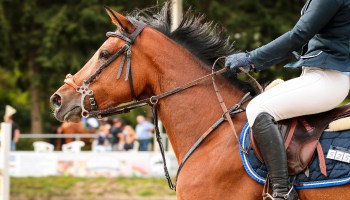
Yes, a horse can show jump in a hackamore or another bitless bridle in some competitions, but the answer depends on the discipline, level, governing body, and exact bridle design. A hackamore is not automatically gentler than a bit, and “bitless” does not mean “no pressure.” Before entering a class, read the current rulebook and confirm the tack with show management or the steward.
For everyday jumping, the more important question is whether the horse is comfortable, educated, responsive, and safely controllable in that bridle. A bitless setup should never be used to mask a training, pain, saddle-fit, or tack problem.
Are hackamores legal for show jumping?
There is no single worldwide answer. Rules differ between national federations, disciplines, class levels, and show organizations. The 2026 United States Equestrian Federation Jumper Division rules refer to equipment attached to a bit, hackamore, or bridle, but competitors still need to check the complete current chapter and any class-specific restrictions.
The FEI Jumping Rules page is the starting point for international competition. FEI, USEF, British, Canadian, and local show rules are not interchangeable. A bridle that is accepted in one jumper class may be restricted in another discipline or at a different level.
Do not rely on an old article, a tack-shop description, or another rider’s experience as proof that your equipment is legal. Verify the current rulebook, the exact model, and the class conditions before you compete.
What is a hackamore?
A hackamore is a bitless bridle that controls the horse through pressure and contact on areas such as the nose, jaw, chin groove, cheeks, or poll. The term covers several designs, and their action can be very different.
Mechanical hackamores
A mechanical hackamore uses shanks and a curb strap or chain to create leverage. The longer the shanks, the tighter the curb, and the more abrupt the rein action, the greater the potential pressure. A mechanical hackamore can be severe in inexperienced hands and may not provide the clear lateral feel some horses need before a turn or related distance.
Sidepulls and direct-action bitless bridles
A sidepull attaches the reins more directly to the noseband. It usually offers clearer direct lateral pressure than a shanked hackamore, but it still depends on correct fit, educated hands, and a horse that understands the aids. A sidepull is not automatically suitable for a fast jumping round just because it has no metal mouthpiece.
Bosals and other designs
Western-style bosals and other bitless bridles have their own fitting and training requirements. They should not be treated as interchangeable with a jumper-style sidepull or mechanical hackamore. Learn how the specific design works before jumping in it.
Can you safely jump a horse in a hackamore?
Some horse-and-rider combinations can jump safely in a suitable bitless bridle. Safety depends on the individual, not on the label printed on the bridle. The horse should be able to maintain rhythm, respond to half-halts, steer through turns, slow down without panic, and remain attentive in a busy environment.
Test the setup gradually. Begin on the flat in a controlled arena, then use poles, small fences, and simple courses. Practice stopping, turning, and returning to a calm rhythm before increasing height, speed, or distractions. If the horse becomes stronger, frightened, evasive, or difficult to steer, go back a step rather than increasing rein pressure.
Use a qualified trainer when changing bridles, especially with a horse that has a history of bolting, rearing, running through the hand, or resisting the bit. A veterinarian or equine dental professional should assess persistent head tossing, mouth opening, reluctance to go forward, or other signs of pain.
Is a hackamore more humane than a bit?
Not automatically. Both bits and bitless bridles can be comfortable when correctly selected, fitted, and used—or painful when used roughly or incorrectly. A bitless bridle can concentrate pressure on the nasal bones, chin, cheeks, or poll. A mechanical hackamore can amplify a small rein movement through leverage.
Look beyond the horse’s mouth. Check for rubs, swelling, hair loss, pressure marks, unusual resistance, changes in breathing, and behavior after work. A horse that is quiet is not necessarily comfortable, so combine behavior with a careful physical check and professional advice when needed.
How should a hackamore fit for jumping?
- The noseband must sit on the appropriate strong area of the nasal bones, not low on the soft tissue.
- The bridle must remain stable without being tightened so much that it restricts breathing or creates constant pressure.
- A curb strap or chain should be fitted according to the manufacturer’s instructions and the design’s intended action.
- There should be no rubbing at the nose, jaw, cheekbones, or behind the ears.
- Reins, clips, and attachments should be secure and appropriate for the competition rules.
- Have a knowledgeable trainer or fitter assess the setup while the horse moves, not only while standing still.
When might a bitless bridle be a poor choice?
A bitless bridle may be the wrong tool if the horse cannot be stopped or turned reliably in it, if the rider is using it to avoid fixing a training issue, or if the horse’s anatomy makes the equipment difficult to fit without pressure on sensitive areas. It may also be unsuitable for a particular class even when it works well at home.
Jumping is not the place to experiment for the first time. A horse that is manageable in a quiet arena may react differently in a warm-up ring, at a new venue, or when another horse passes close by. Build reliability before competing, and choose the equipment that gives the horse clear, humane communication and the rider appropriate control.
Frequently asked questions
Can you show jump in a mechanical hackamore?
Possibly, depending on the current rules of the federation, discipline, class, and show. Check the exact rulebook and confirm the model with show management before entering.
Is a bitless bridle legal in every show-jumping class?
No. Equipment rules vary. A bridle accepted in one country, organization, or class may be restricted elsewhere, so never assume that “bitless” means universally legal.
Does a hackamore give better control than a bit?
Not by itself. Control comes from training, fit, rider balance, clear aids, and the horse’s response. A leverage hackamore can increase pressure but does not replace education or good riding.
What should I do if my horse runs through a hackamore?
Stop jumping and return to controlled flatwork with qualified help. Check the bridle fit, saddle, teeth, feet, and musculoskeletal comfort before assuming the horse simply needs a stronger aid.
Related jumping and tack guides
- What Is a Hackamore and What Is It Used For?
- Why Do Show Jumpers Wear Ear Covers?
- 29 Horse Jumping Obstacles Explained for Beginners
- Is Show Jumping Dangerous?
Sources: United States Equestrian Federation 2026 Jumper Division rules; FEI Jumping Rules.

Written by
I've been around horses since I was 6 years old and started competing at the age of 9. Horses are my greatest passion and I am thrilled to be able to share my 23 (and counting) years of experience and knowledge with you.